First-party data has become a reliable way for publishers to prove performance and build more resilient revenue. This article breaks down why it matters now, and how leading publishers are turning consented, user-declared signals from polls into segments and results they can actually activate.

Modern publishing is under pressure
Publishers are under growing pressure to prove performance while operating in a market that is becoming harder to measure, target, and monetize. Attention is fragmenting, privacy expectations are rising, and buyers increasingly want to understand and activate their audiences with confidence.
The First-Party Data Solution
In this environment, first party data has become one of the most practical tools available to publishers, especially when it is user-declared and consent-based. It helps strengthen direct advertiser relationships, build privacy-safe segments, and create repeatable value from audience engagement, without relying on external identifiers.
Turning Polls into User Intent Data
Opinary is already partnering with publishers like Daily Mail Group, Funke Media Group, and Burda Forward to support first party data collection through on-site polls and other audience interaction tools. By engaging audiences with relevant questions, publishers can capture sociodemographic insights alongside intent data and feed those signals into their DMP in real time. This approach turns participation into actionable audience understanding, including user intent data and richer customer intent data, that teams can actually activate across sales, targeting, and content strategies.
Leading Publishers, Leading First-Party Data Strategies
To illustrate the impact of first- and zero-party data, here are some publishers who have already made significant strides in this area:
-
By accelerating its 1st party data strategy with a clear focus on addressability and direct revenue, The New York Post has been building authenticated relationships via newsletters and alternative identifiers, using those signals to build audiences that support more direct deals and higher-value campaign planning.
-
Bauer Media Group has scaled a first party data approach across a large portfolio, packaging unique audience insights for advertisers and proving measurable impact. In a case study, Bauer reports a 75% increase in revenue, a 152% increase in advertiser count, and a 31% year-over-year increase in average CPM, supported by audience and campaign insights that help sales teams sell beyond individual brands.
-
Bloomberg offers a strong signal of where the market is heading: after shifting away from third-party programmatic approaches, Bloomberg reportedly saw a 20% uplift in advertising CPMs, reinforcing how owned, consented data can directly translate into commercial resilience.
Declared Data from Polls: Best Practice
Additionally, our publisher partners offer concrete examples of how poll-generated first-party signals can translate into measurable commercial results:
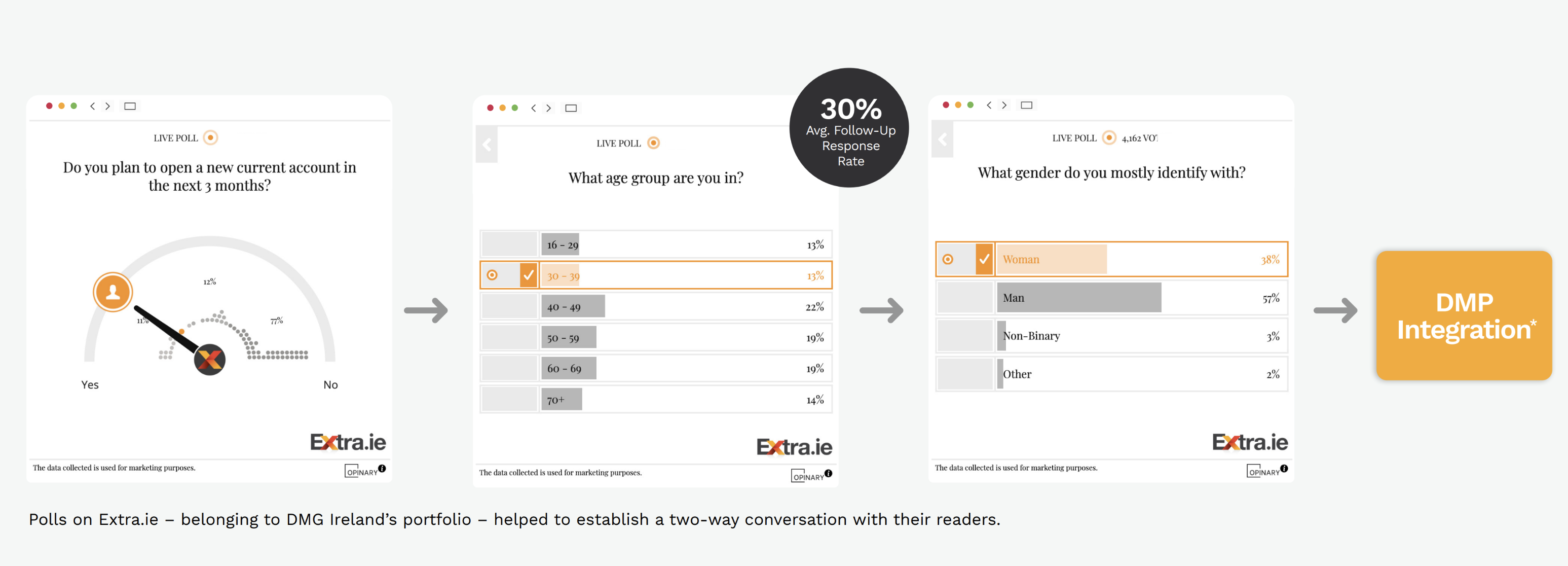
Daily Mail Group Ireland (DMG) offers a compelling success story. In an interview, Doug Farrell, DMG’s Head of Digital Media, highlighted how Opinary’s in-article polls help capture audience attention and turn it into actionable signals for targeting and performance. The collaboration resulted in a 60% increase in CTRs, an 80% boost in brand engagement, and a 40% increase in CPMs, demonstrating the value that publisher-owned, declared data can bring to campaign performance and client outcomes.
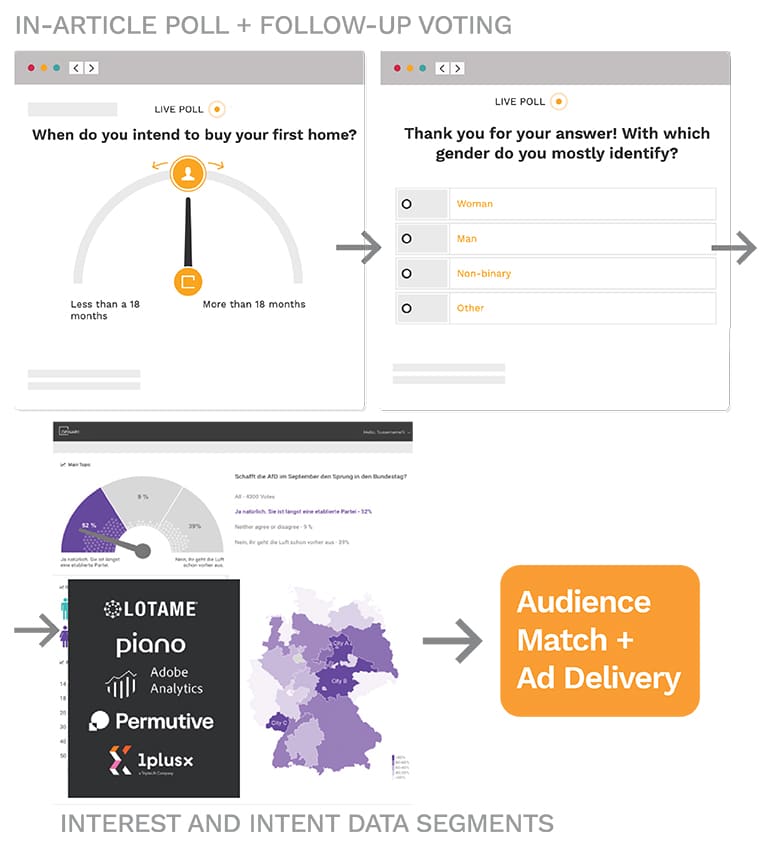
BCN has focused on creating user habits with regular, editorial-driven questions that consistently add value and prove that quality beats volume. Instead of chasing millions of passive signals, BCN found that around 1,000 high-intent responses are enough to build audience segments that performed strongly. The difference comes down to asking better questions and using the right audience participation tools to make participation feel natural. When a poll feels like a conversation rather than a form, relevance goes up and so do response rates. Operationally, BCN connected the full stack by using Opinary for survey collection and DMP Permutive for activation, enabling a real-time flow from poll response to targeting, including scalable segments built on declared interest and intent signals.
If you are interested to learn more about how DMG and BCN leveraged first-party data, click here:
Recent Comments