
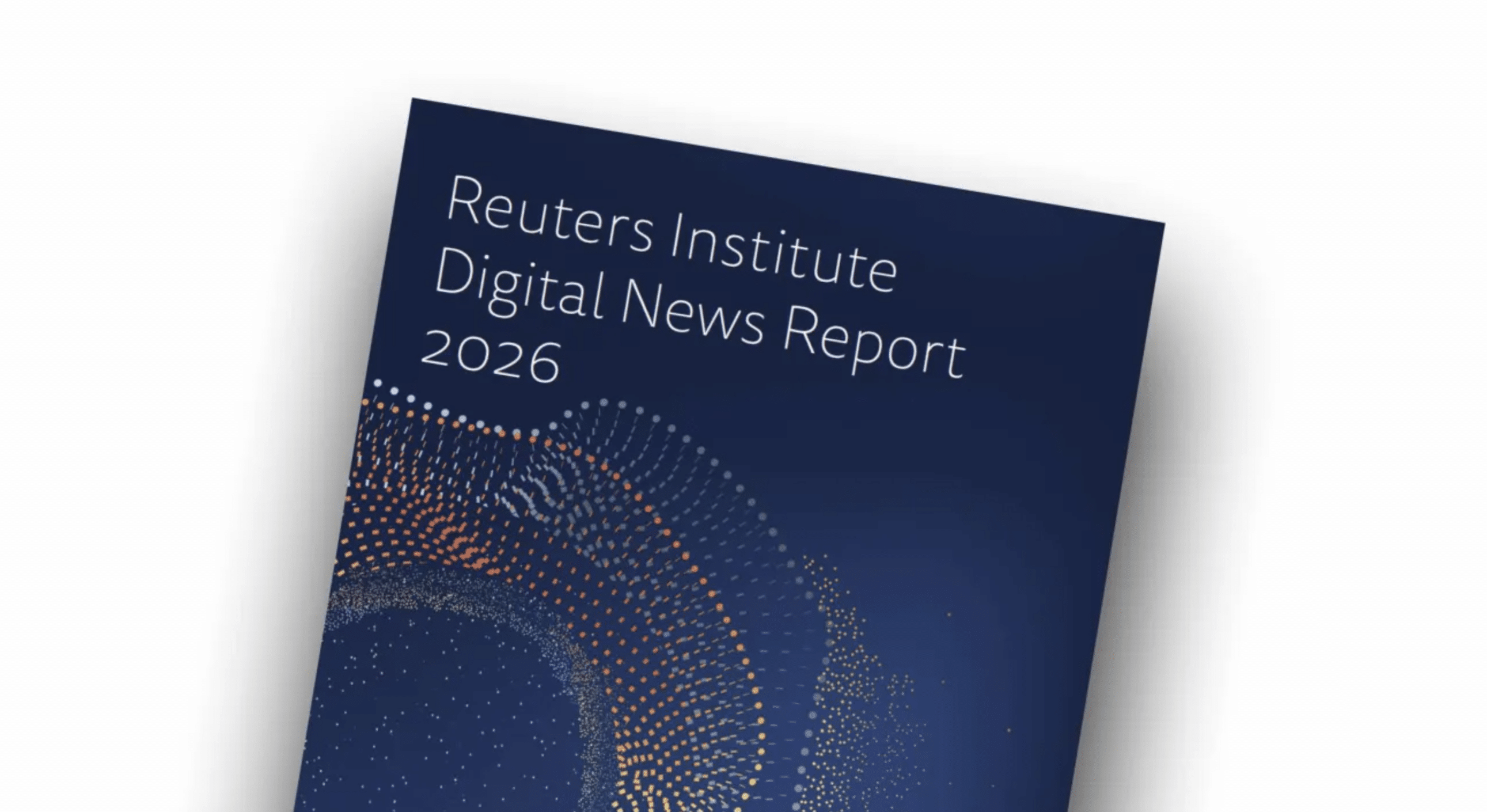
The 2026 Reuters Institute Digital News Report reads, in places, like an obituary for the old publishing playbook. Trust in news has fallen to its lowest level on record. Interest in news is down 13 percentage points since 2021. And for the first time, social platforms and video networks have overtaken publishers’ own websites and apps as the most common way people access news worldwide.
Behind those headlines sits a single, uncomfortable shift: the era of chasing ever-bigger audiences is over. The publishers thriving in 2026 aren’t the ones with the most traffic — they’re the ones turning the readers they already have into loyal, returning, paying members of a community.
That’s a change in what publishers must do on the page. Broadcasting more content at readers no longer works. The Reuters report is blunt about this: the answer is unlikely to lie in producing more content or in peppering people’s lockscreens with more notifications. What works is the opposite — inviting readers in, giving them a role, and making them feel part of something.
This is exactly what a well-placed reader poll does. Instead of asking a visitor to passively scroll, it asks them one simple question: what do you think? That single interaction transforms a passive reader into an active participant — and active participants come back, engage more deeply, and are far more likely to pay.
Below are three of the most urgent problems the 2026 Reuters report surfaces, and how leading publishers are already solving each one with Opinary.
PROBLEM 1
The audience is shrinking, but the loyal core is worth more than ever
The most consequential line in the entire Reuters report may be this: many publishers have moved on from measuring audience reach as a key success metric, instead prioritising the depth of engagement with a smaller, more loyal audience.
This is the “smaller but more loyal audience” pivot, and it is now industry consensus. Interest in news is falling, and a quarter of people are now casual or passive users, up from 16% in 2021. But the committed “news lovers” who remain are undiminished in how much they consume — and in their willingness to pay. The strategic imperative has flipped from how do we reach more people? to how do we deepen our relationship with the people we’ve got?
Reach is a vanity metric in 2026. Engagement depth is the metric that predicts revenue.
BEST PRACTICE
Yahoo’s “Poll of the Week” turns readers into a returning community
Yahoo UK built an entire recurring format around this idea. Its Poll of the Week invites readers to vote on the topics dividing the country — from politics and council tax to winter fuel payments and working from home — then publishes an editorial analysis of the results later in the week, so the community can revisit how their view compares to everyone else’s.
“The goal was to develop a poll-based article format that would keep people coming back week after week”
Alexander Kay
Senior Editor, Yahoo UK
It worked. Strong topics engage more than half of readers, driving engagement rates of up to 60% — three times the site average.
The post-vote banner recirculating readers to the PotW landing page earned a click-through rate of over 3.2%, higher than any of Yahoo’s other post-vote banners, signalling genuine, growing affinity for the format.
Yahoo has since deepened the community angle further, inviting readers to comment on each week’s topic and featuring the best submissions in the follow-up article. That’s the “smaller but more loyal audience” pivot made real: not more readers, but a returning, invested community that treats the poll as a weekly ritual.
PROBLEM 2
“Google Zero” means every on-site visitor is precious
The second shock in the 2026 data is the collapse of referral traffic. Google organic search traffic to more than 2,500 sites fell by roughly a third globally between November 2024 and November 2025 — and by 38% in the US. Publishers now expect search referrals to almost halve over the next three years as AI Overviews and AI Mode absorb the clicks that once flowed to news sites.
The industry calls it “Google Zero.” Its practical effect is simple and severe: fewer readers arrive, and the ones who do are more valuable than ever. When you can no longer count on a firehose of casual search traffic, you have to extract far more relationship — and loyalty — from each visitor who does land on your page. Depth has to compensate for the disappearing top of the funnel.
BEST PRACTICE
The Economist builds subscriber loyalty that survives the traffic drought
The Economist’s answer is to make its existing relationship with subscribers unbreakable. The publication’s own research shows that subscribers who feel a personal connection to the brand are significantly more likely to renew.
So when The Economist launched its Insider newsletter in October 2025, it built reader polls into the core of the experience. Editor-in-chief Zanny Minton Beddoes previews the week’s biggest newsroom debates, and subscribers shape those conversations by voting in Opinary polls — the results of which the editors then discuss on the weekly Insider show, revealing how they would have voted themselves.
The result is a self-reinforcing loop that has nothing to do with search traffic. Readers cast around 75,000 votes in the first three months, and on average 30% of readers who vote in a poll then click through to the relevant episode page.
“Polls have become an important part of The Economist Insider. They create a virtuous cycle in which the newsletters drive show engagement and the shows enhance newsletter content.”
Miriam Hymer
Senior Audience Editor, The Economist
In a “Google Zero” world, that owned, participatory relationship — one you don’t have to re-buy from a platform every day — is the most defensible asset a publisher can build.
PROBLEM 3
The subscription funnel is narrowing, so retention and conversion win
The third problem hits the business model directly. Paying for news has flatlined at around 17% across established markets, and the Reuters report is clear about why: the stagnation reflects the long-term decline in the use of owned sites and apps, which have lost 12 percentage points of reach since 2021 — shrinking the top of the subscription funnel.
With fewer new visitors entering the funnel, growth can no longer come from acquisition alone. The winning publishers are those maximising conversion and retention from the audience already on the page — re-establishing trust and perceived value so that engaged readers take the step to pay.
BEST PRACTICE
Best practice: Tagesspiegel converts engaged readers into paying subscribers
German publisher Der Tagesspiegel faced this challenge head-on with its paid offering, Tagesspiegel Plus. In a climate of low willingness to pay, it needed to re-establish value and interest before asking for the sale.
Its approach uses Opinary’s polls to do exactly that. Placed hyper-contextually inside relevant articles, the polls first activate readers with a question. After voting, an engaged reader is shown a banner thanking them for their vote and offering a special trial-subscription reward they can redeem in a couple of clicks. Tagesspiegel A/B-tested banner variations continuously to sharpen the message.
The results speak directly to the retention-and-conversion imperative:
282% increase in trial subscriptions
4.5% banner click rate – double the campaign’s starting point
+57% lift in banner interaction among readers with an affinity for the brand
“Der Tagesspiegel has been using Opinary successfully since 2019, both on our website and in our newsletter — as a tool for acquiring trial subscriptions and in marketing. We are extremely pleased about the trusted and professional partnership.”
Farhad Kahlil
Ex-Managing Director and CDO, Verlag der Tagesspiegel GmbH
The lesson: you convert the reader who’s already leaning in. Engagement isn’t a nice-to-have adjacent to subscriptions, it’s what leads to them.
The through-line: engagement is the strategy now
The 2026 Reuters report describes a genuinely harder environment: less trust, less interest, less traffic, and a subscription ceiling that isn’t rising. But it also points, again and again, to the same escape route. Publishers win by deepening engagement with a loyal core, by owning relationships that don’t depend on platforms, and by converting the engaged readers they already have.
Reader polls sit precisely at that intersection. They turn passive scrolling into active participation, participation into loyalty, and loyalty into revenue — while generating declared first-party data along the way. That’s why 90% of Germany’s biggest publishers, and more than 160 publications worldwide, use Opinary.
The publishers thriving in 2026 aren’t asking how to reach more people. They’re asking their readers a better question — what do you think? — and building everything from the answer
Recent Comments